A reference archive for mechanical timekeeping
Explore the World of Horology
An educational encyclopedia dedicated to pocket watches, mechanical watches, clocks, movements, watchmakers, history, and the science of mechanical timekeeping.
- 36
- Pocket watch types
- 36
- Movement records
- 30
- Maker entries
- 148
- Glossary terms
The archive is built to grow: each record is a standalone reference page with editorial status, cited sources and cross-references into the wider knowledge graph.
Explore horology
The reference sections
Flagship specialty
Explore pocket watches
 EscapementVerge WatchesWatches regulated by a verge (crown-wheel) escapement, in which a vertical staff carrying two pallets engages a horizontally mounted crown wheel.c. 1500 – c. 1860
 EscapementCylinder WatchesWatches using the cylinder (horizontal) escapement, in which a hollow cut cylinder on the balance staff receives impulse directly from raised escape-wheel teeth.c. 1725 – c. 1930
 PurposeRailroad WatchesHigh-grade pocket watches built to railway timekeeping standards, typically requiring lever escapement, 17 or more jewels, adjustment to temperature and positions, and an open-face dial with bold arabic numerals.c. 1870 – c. 1960
 CaseHunter-Case WatchesPocket watches with a hinged metal cover protecting the crystal and dial, sprung open by a push of the crown.c. 1800 – present
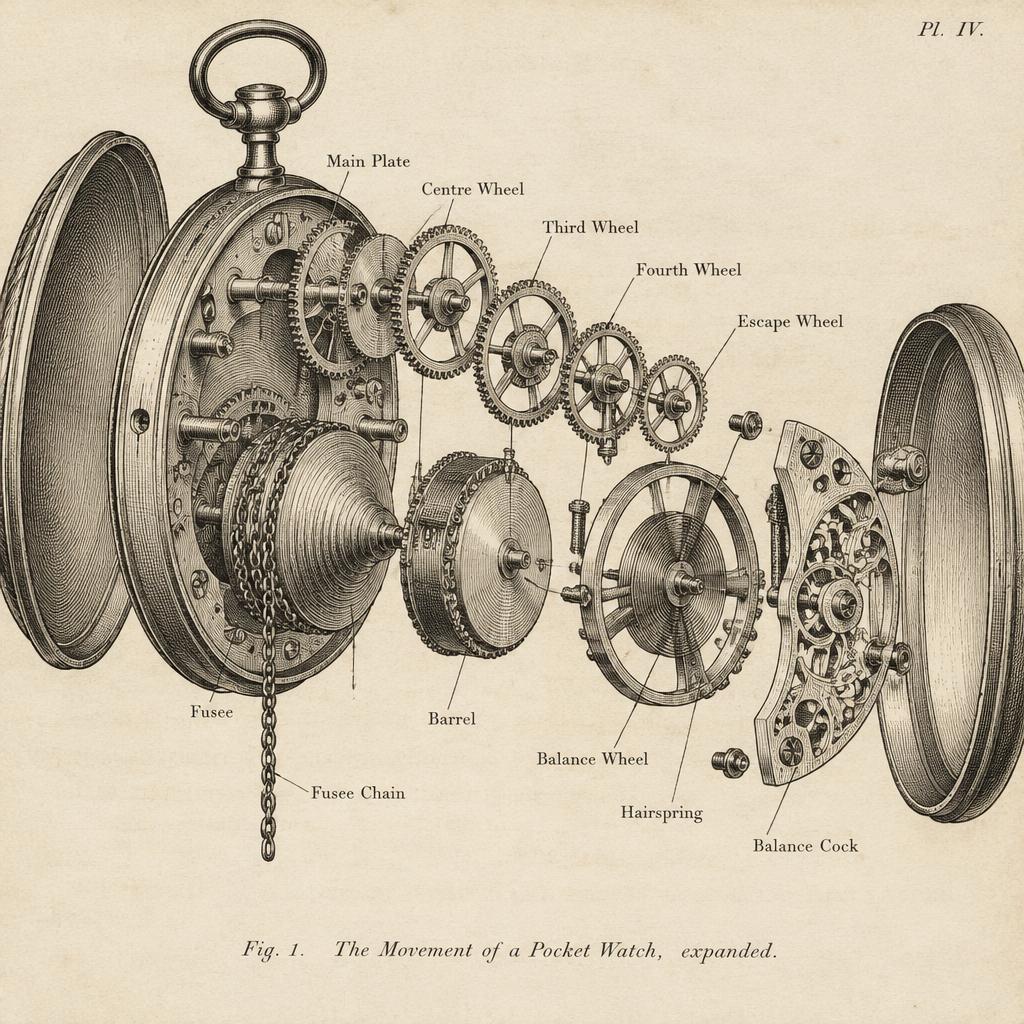
 WindingFusee Pocket WatchesWatches in which the mainspring drives a tapered, grooved pulley (the fusee) through a chain or gut line, equalising torque as the spring unwinds.c. 1500 – c. 1900
 ComplicationRepeater Pocket WatchesWatches that sound the time on demand, striking hours and subdivisions on a bell or gongs when a slide or pusher is operated.c. 1680 – present
 CasePair-Cased WatchesWatches housed in an inner case carrying the movement and an outer protective case, the pair normally hallmarked separately.c. 1650 – c. 1850
 PurposeMilitary Pocket WatchesPocket watches procured to government or service specification, usually plain, robust and marked with issue numbers or broad arrows.c. 1880 – c. 1950
Featured records
Movement, maker, mechanism
 Featured movementHamilton 992BThree-quarter plate nickel movement with damascened finish, motor barrel and micrometric regulator; designed specifically to satisfy railway time-service requirements.1940 – 1969 · 21 jewels
 Featured makerThomas Tompion (workshop)Often called the father of English clockmaking, Tompion's workshop produced numbered clocks and watches of exceptional quality, collaborating with Robert Hooke and George Graham on escapement and balance-spring work.London · from c. 1671 (Clockmakers' Company)Featured mechanismDetent (chronometer) escapementA spring or pivoted detent locks the escape wheel; the balance unlocks it once per revolution and receives a single direct impulse, remaining otherwise entirely free.Late eighteenth century, associated with Earnshaw and Arnold
Chronology
Horology timeline
c. 1500 BCE
Shadow clocks and sundials
Egyptian shadow clocks divide daylight into unequal hours; sundial practice spreads across the Mediterranean world.
c. 1400 BCE
Water clocks (clepsydrae)
Outflow and inflow water clocks permit timekeeping at night, developed further by Greek and later Islamic engineers.
c. 250 BCE
Geared astronomical calculation
The Antikythera mechanism, recovered from a Mediterranean wreck, shows sophisticated bronze gearing used for astronomical prediction. Its exact purpose and dating remain subjects of scholarly debate.
c. 1088
Su Song's astronomical clock tower
The Chinese engineer Su Song completes a water-driven astronomical clock tower with an escapement-like tipping mechanism, described in his own treatise.
c. 1275–1300
The mechanical escapement appears
Weight-driven verge-and-foliot clocks appear in European monastic and civic settings. No single inventor can be identified.
c. 1510
Portable spring-driven watches
Spring-driven drum watches emerge in southern Germany; Peter Henlein is associated with early examples though the popular 'first watch' claim is not supported.
Resources
Collector's library, museums & articles
Latest articles
- Why English Watchmaking Declined
England led the world in precision watchmaking for over a century, then lost the industry within two generations. The reasons are structural rather than technical.
- Reading an Unknown Movement
Before searching a serial number, describe the movement. Architecture, escapement and winding system usually narrow an attribution further than a signature does.
- Condition Grading Without Illusions
Grading vocabulary is not standardised across auction houses, dealers and collectors. Describe what you can see instead of reaching for a single word.
- How the Railroad Made the American Watch
Railroad timekeeping standards did not simply demand better watches; they defined a specification that reorganised an entire industry around inspection, adjustment and legibility.
- Fusee Versus Going Barrel: A Two-Century Argument
The fusee equalises mainspring torque almost perfectly. The going barrel does not. The going barrel won anyway, and the reasons explain much about how watchmaking industrialised.
- Dating a Watch From Its Case — and Why That Can Mislead
In the English tradition, hallmarks date the case precisely. They do not date the movement, and treating them as one date is the most common error in pocket watch research.
- What a Minute Repeater Actually Does
A repeater sounds the time on demand. Behind that simple description lies one of the most demanding mechanisms in portable horology, and one of the easiest to damage.
- Conservation or Restoration: Deciding What Not to Do
Every intervention removes evidence. Museum conservation practice offers collectors a framework for deciding which interventions are justified.
- Reading a Swiss Bar Movement Without a Signature
Most Swiss pocket watches are unsigned or bear a retailer's name. Attribution then depends on ébauche architecture, marks and case evidence rather than on a brand.
- The Quartz Crisis and What Followed
Electronic timekeeping did not merely compete with the mechanical watch; it removed accuracy as the reason to buy one. What survived had to justify itself differently.
- What Jewel Counts Really Tell You
A jewel count describes where friction was reduced, not how good a watch is. Reading the count means knowing which bearings were jewelled and which were not.
- Reading American Factory Serial Records
American factory records make dating unusually tractable — provided you understand what a published serial table actually claims.
- The Marine Chronometer and the Longitude Problem
Finding longitude at sea required a clock that kept time through months of motion, damp and temperature change. Solving it reshaped precision horology.
- How the Pocket Watch Became the Wristwatch
The wristwatch was not a new mechanism. It was a small pocket watch relocated, and every design change follows from that relocation.
- Why Old Oil Destroys Movements
A dirty movement that still runs is doing damage. Degraded lubricant is abrasive, and the wear it causes is not reversible.
- How a Pendulum Clock Keeps Time
A pendulum clock counts swings. Everything else in the case exists to keep the pendulum swinging and to record the count.
- Buying a First Pocket Watch
The most useful first purchase is a documented, serviceable, ordinary watch — not a rarity bought before you can read one.
- Frankenwatches and Composite Objects
Most misdescribed watches are not forgeries. They are genuine parts assembled into an object that never left a factory that way.
- How Temperature Compensation Works
Heat weakens a balance spring and expands a balance wheel. Precision watchmaking spent a century cancelling both effects.
- How Mass Production Changed Watchmaking
Interchangeable parts did more than lower prices. They changed what a watch was, who could repair it, and what records survive for researchers.
- Reading Hallmarks on a Watch Case
Hallmarks date the case, not the watch. Read them carefully and they give a place, a metal standard and often a year.
- What Makes a Railroad-Grade Watch
Railroad grade was a specification enforced by inspection, not a marketing word. The requirements are visible in the watch.
- The Swiss Établissage System
Swiss watches were assembled from a distributed supply chain. Understanding that chain explains why so many fine watches carry no maker's name.
- Storing and Handling Antique Clocks
More antique clocks are damaged in transport and storage than on the bench. Most of that damage is avoidable.
- How a Chronograph Works
A chronograph adds a second, startable timing train to a running watch. Almost every design question follows from that addition.
- Researching an Unsigned Clock
Most surviving clocks carry no maker's name. Case style, movement construction and the escapement usually place them anyway.
- Building a Coherent Collection
A collection with a thesis teaches more than a collection of highlights, and it is easier to research, document and eventually pass on.
Recommended books
- Old Clocks and Watches and Their Makers — F. J. Britten
- Clock and Watch Escapements — W. J. Gazeley
- Watch and Clock Making and Repairing — W. J. Gazeley
- Watches 1850–1980 — M. Cutmore
- Watch Case Makers of England — Philip Priestley
Featured museums
- Musée international d'horlogerie — La Chaux-de-Fonds, Switzerland
- The Clockmakers' Museum — London, United Kingdom
- Royal Museums Greenwich — London, United Kingdom
- Deutsches Uhrenmuseum — Furtwangen, Germany
- National Watch and Clock Museum (NAWCC) — Columbia, Pennsylvania, United States